How Do You Know You Need to Standardize Data
Standardization or standardisation is the procedure of implementing and developing technical standards based on the consensus of different parties that include firms, users, interest groups, standards organizations and governments.[1] Standardization can assistance maximize compatibility, interoperability, safety, repeatability, or quality. It can too facilitate a normalization of formerly custom processes. In social sciences, including economics,[two] the idea of standardization is close to the solution for a coordination trouble, a situation in which all parties tin realize mutual gains, merely only past making mutually consistent decisions. Standardization is creating emotional residue, conventional detail, a universal familiarity and natural definition to a concept based on physical or emotional comfort and acceptance by changing societal behaviors and developments.
History [edit]
Early examples [edit]
Standard weights and measures were developed by the Indus Valley Civilization.[3] The centralized weight and measure out organization served the commercial interest of Indus merchants every bit smaller weight measures were used to measure luxury goods while larger weights were employed for ownership bulkier items, such as nutrient grains etc.[4] Weights existed in multiples of a standard weight and in categories.[4] Technical standardisation enabled gauging devices to be finer used in athwart measurement and measurement for construction.[5] Uniform units of length were used in the planning of towns such every bit Lothal, Surkotada, Kalibangan, Dolavira, Harappa, and Mohenjo-daro.[iii] The weights and measures of the Indus culture too reached Persia and Central Asia, where they were further modified.[half-dozen] Shigeo Iwata describes the excavated weights unearthed from the Indus civilization:
A total of 558 weights were excavated from Mohenjodaro, Harappa, and Chanhu-daro, not including defective weights. They did not observe statistically significant differences between weights that were excavated from five different layers, each measuring near 1.five k in depth. This was evidence that strong control existed for at least a 500-year catamenia. The thirteen.seven-g weight seems to be ane of the units used in the Indus valley. The note was based on the binary and decimal systems. 83% of the weights which were excavated from the above 3 cities were cubic, and 68% were made of chert.[three]
18th century attempts [edit]
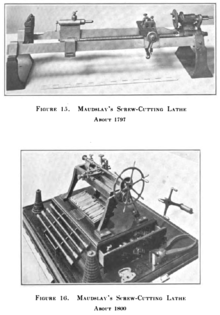
Henry Maudslay'southward famous early screw-cutting lathes of circa 1797 and 1800.
The implementation of standards in industry and commerce became highly important with the onset of the Industrial Revolution and the need for loftier-precision machine tools and interchangeable parts.
Henry Maudslay developed the first industrially practical screw-cutting lathe in 1800. This allowed for the standardization of spiral thread sizes for the first fourth dimension and paved the way for the practical application of interchangeability (an idea that was already taking hold) to nuts and bolts.[vii]
Before this, screw threads were commonly fabricated by chipping and filing (that is, with skilled freehand use of chisels and files). Nuts were rare; metal screws, when made at all, were usually for use in woods. Metal bolts passing through forest framing to a metal fastening on the other side were usually fastened in non-threaded ways (such as clinching or upsetting against a washer). Maudslay standardized the screw threads used in his workshop and produced sets of taps and dies that would make nuts and bolts consistently to those standards, and then that any bolt of the advisable size would fit any nut of the same size. This was a major accelerate in workshop technology.[8]
National standard [edit]
Maudslay's work, as well as the contributions of other engineers, achieved a small-scale corporeality of industry standardization; some companies' in-firm standards spread a bit inside their industries.
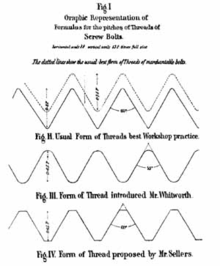
Graphic representation of formulae for the pitches of threads of screw bolts
Joseph Whitworth's spiral thread measurements were adopted as the showtime (unofficial) national standard by companies around the country in 1841. It came to be known as the British Standard Whitworth, and was widely adopted in other countries.[nine] [10]
This new standard specified a 55° thread angle and a thread depth of 0.640327p and a radius of 0.137329p, where p is the pitch. The thread pitch increased with bore in steps specified on a chart. An example of the utilise of the Whitworth thread is the Purple Navy'due south Crimean War gunboats. These were the first instance of "mass-production" techniques existence practical to marine engineering.[7]
With the adoption of BSW past British railway lines, many of which had previously used their own standard both for threads and for bolt head and nut profiles, and improving manufacturing techniques, information technology came to dominate British manufacturing.
American Unified Coarse was originally based on almost the aforementioned royal fractions. The Unified thread angle is 60° and has flattened crests (Whitworth crests are rounded). Thread pitch is the same in both systems except that the thread pitch for the 1⁄2 in. (inch) commodities is 12 threads per inch (tpi) in BSW versus thirteen tpi in the UNC.
National standards body [edit]
By the end of the 19th century, differences in standards betwixt companies, was making trade increasingly difficult and strained. For instance, an atomic number 26 and steel dealer recorded his displeasure in The Times: "Architects and engineers generally specify such unnecessarily diverse types of sectional material or given piece of work that annihilation like economical and continuous manufacture becomes impossible. In this country no ii professional person men are agreed upon the size and weight of a girder to employ for given work."
The Engineering science Standards Commission was established in London in 1901 equally the earth's first national standards body.[xi] [12] It subsequently extended its standardization work and became the British Engineering Standards Clan in 1918, adopting the proper noun British Standards Institution in 1931 after receiving its Majestic Charter in 1929. The national standards were adopted universally throughout the country, and enabled the markets to act more than rationally and efficiently, with an increased level of cooperation.
Afterward the Offset World War, similar national bodies were established in other countries. The Deutsches Institut für Normung was ready in Germany in 1917, followed past its counterparts, the American National Standard Institute and the French Commission Permanente de Standardisation, both in 1918.[vii]
Regional standards organization [edit]
At a regional level (east.g. Europa, the Americas, Africa, etc) or at subregional level (due east.g. Mercosur, Andean Community, Southward Eastern asia, Due south East Africa, etc), several Regional Standardization Organizations exist (see also Standards Organization).
The three regional standards organizations in Europe - or European Standardization Organizations (ESOs) recognised past the EU Regulation on Standardization [Regulation (Eu) 1025/2012] are CEN, CENELEC and ETSI. CEN develops standards for numerous kinds of products, materials, services and processes. Some sectors covered past CEN include transport equipment and services, chemicals, construction, consumer products, defence force and security, energy, food and feed, health and safety, healthcare, digital sector, machinery or services.[13] The European Committee for Electrotechnical Standardization (CENELEC) is the European Standardization organisation developing standards in the electrotechnical surface area and corresponding to the International Electrotechnical Commission (IEC) in Europe.[14]
International standards [edit]
The first modern International Organization (Intergovernmental Organization) the International Telegraph Matrimony (now International Telecommunication Union) was created in 1865[15] to fix international standards in club to connect national telegraph networks, every bit a merger of ii predecessor organizations (Bern and Paris treaties) that had similar objectives, but in more express territories.[16] [17] With the advent of radiocommunication soon after the cosmos, the piece of work of the ITU chop-chop expanded from the standardization of Telegraph communications, to developing standards for telecommunications in full general.
International Standards Associations [edit]
By the mid to late 19th century, efforts were being fabricated to standardize electrical measurement. Lord Kelvin was an of import figure in this process, introducing accurate methods and apparatus for measuring electricity. In 1857, he introduced a series of effective instruments, including the quadrant electrometer, which cover the entire field of electrostatic measurement. He invented the electric current balance, also known as the Kelvin balance or Ampere balance (SiC), for the precise specification of the ampere, the standard unit of electrical current.[18]
R. E. B. Crompton became concerned by the large range of unlike standards and systems used by electrical engineering companies and scientists in the early 20th century. Many companies had entered the market in the 1890s and all chose their own settings for voltage, frequency, current and even the symbols used on circuit diagrams. Adjacent buildings would have totally incompatible electrical systems simply because they had been fitted out by different companies. Crompton could see the lack of efficiency in this system and began to consider proposals for an international standard for electric engineering.[xix]
In 1904, Crompton represented Britain at the International Electrical Congress, held in connection with Louisiana Purchase Exposition in Saint Louis every bit role of a delegation by the Institute of Electrical Engineers. He presented a paper on standardisation, which was so well received that he was asked to expect into the formation of a commission to oversee the procedure.[xx] By 1906 his piece of work was complete and he drew up a permanent constitution for the International Electrotechnical Commission.[21] The body held its offset meeting that year in London, with representatives from fourteen countries. In honour of his contribution to electrical standardisation, Lord Kelvin was elected equally the torso's first President.[22]
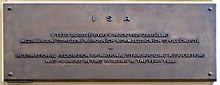
Memorial plaque of founding ISA in Prague.
The International Federation of the National Standardizing Associations (ISA) was founded in 1926 with a broader remit to enhance international cooperation for all technical standards and specifications. The trunk was suspended in 1942 during World War II.
After the war, ISA was approached past the recently formed United Nations Standards Analogous Commission (UNSCC) with a proposal to form a new global standards body. In October 1946, ISA and UNSCC delegates from 25 countries met in London and agreed to join forces to create the new International Organization for Standardization (ISO); the new organization officially began operations in February 1947.[23]
In general, each land or economy has a single recognized National Standards Body (NSB). Examples include ABNT, AENOR (now called UNE, Castilian Association for Standardization), AFNOR, ANSI, BSI, DGN, DIN, IRAM, JISC, KATS, SABS, SAC, SCC, SIS. An NSB is likely the sole member from that economic system in ISO.
NSBs may be either public or private sector organizations, or combinations of the two. For instance, the three NSBs of Canada, Mexico and the United States are respectively the Standards Council of Canada (SCC), the General Agency of Standards ( Dirección General de Normas , DGN), and the American National Standards Institute (ANSI). SCC is a Canadian Crown Corporation, DGN is a governmental agency within the Mexican Ministry of Economy, and ANSI and AENOR are a 501(c)(3) non-profit organization with members from both the private and public sectors. The determinants of whether an NSB for a detail economy is a public or private sector body may include the historical and traditional roles that the individual sector fills in public diplomacy in that economic system or the development stage of that economy.
Usage [edit]
Standards tin be:
- de facto standards which means they are followed by informal convention or dominant usage.
- de jure standards which are part of legally binding contracts, laws or regulations.
- Voluntary standards which are published and available for people to consider for employ.
The existence of a published standard does not necessarily imply that it is useful or correct. Just because an particular is stamped with a standard number does not, past itself, indicate that the item is fit for whatsoever particular apply. The people who utilise the item or service (engineers, trade unions, etc.) or specify it (building codes, government, industry, etc.) have the responsibleness to consider the available standards, specify the correct one, enforce compliance, and use the item correctly: validation and verification.
To avoid the proliferation of industry standards, as well referred to every bit individual standards, regulators in the United States are instructed by their government offices to adopt "voluntary consensus standards" before relying upon "industry standards" or developing "government standards".[24] Regulatory authorities tin reference voluntary consensus standards to translate internationally accepted criteria into public policy.[25] [26]
Information exchange [edit]
In the context of data substitution, standardization refers to the process of developing standards for specific concern processes using specific formal languages. These standards are usually developed in voluntary consensus standards bodies such equally the United Nations Centre for Merchandise Facilitation and Electronic Business (Un/CEFACT), the World Wide Web Consortium (W3C), the Telecommunications Industry Association (TIA), and the System for the Advancement of Structured Data Standards (Oasis).
There are many specifications that govern the performance and interaction of devices and software on the Net, only they are rarely referred to as standards, so as to preserve that word as the domain of relatively disinterested bodies such as ISO. The W3C, for example, publishes "Recommendations", and the IETF publishes "Requests for Comments" (RFCs). Withal, these publications are sometimes referred to as standards.
Environmental protection [edit]
Standardized product certifications such every bit of organic food, buildings or possibly sustainable seafood equally well as standardized production rubber evaluation and dis/blessing procedures (e.chiliad. regulation of chemicals, cosmetics and nutrient safety) can protect the environment.[27] [28] [29] This effect may depend on associated modified consumer choices, strategic production support/obstruction, requirements and bans equally well equally their accordance with a scientific ground, the robustness and applicability of a scientific ground, whether adoption of the certifications is voluntary, and the socioeconomic context (systems of governance and the economy), with possibly nearly certifications being so far mostly largely ineffective.[30] [ additional commendation(s) needed ]
Moreover, standardized scientific frameworks tin enable evaluation of levels of environmental protection, such as of marine protected areas, and serve as, potentially evolving, guides for improving, planning and monitoring the protection-quality, -scopes and -extents.[31]
Moreover, technical standards could decrease electronic waste material[32] [33] [34] and reduce resources-needs such equally by thereby requiring products to be interoperable, compatible, durable, energy-efficient, modular,[35] upgradeable/repairable[36] and recyclable and adapt to versatile, optimal standards and protocols. The domain of such standardization is non limited to electronic devices like smartphones and telephone chargers only could also be applied to east.g. the free energy infrastructure. Policy-makers could develop policies "fostering standard design and interfaces, and promoting the re-use of modules and components across plants to develop more than sustainable energy infrastructure".[37] Computers and the Cyberspace are some of the tools that could be used to increase practicability and reduce suboptimal results, detrimental standards and bureaucracy, which is often associated with traditional processes and results of standardization.[38] Taxes and subsidies, and funding of research and development could be used complementarily.[39]
Product testing and analysis [edit]
In routine product testing and product analysis results can be reported using official or informal standards. It can be done to increase consumer protection, to ensure safety or healthiness or efficiency or performance or sustainability of products. It can exist carried out by the manufacturer, an contained laboratory, a government agency, a mag or others on a voluntary or mandated ground.[40] [41] [ additional citation(s) needed ]
Safety [edit]
Public data symbols [edit]
Public information symbols (e.g. hazard symbols), peculiarly when related to prophylactic, are often standardized, sometimes on the international level.[42]
Biosafety [edit]
Standardization is also used to ensure safe design and performance of laboratories and similar potentially dangerous workplaces, east.yard. to ensure biosafety levels.[43] There is research into microbiology safety standards used in clinical and research laboratories.[44]
Defense [edit]
In the context of defense, standardization has been defined by NATO as The development and implementation of concepts, doctrines, procedures and designs to attain and maintain the required levels of compatibility, interchangeability or commonality in the operational, procedural, cloth, technical and administrative fields to achieve interoperability. [45]
Ergonomics, workplace and health [edit]
In some cases, standards are existence used in the blueprint and performance of workplaces and products that tin touch on consumers' health. Some of such standards seek to ensure occupational safety and health and ergonomics. For example, chairs[42] [46] [47] [48] (meet e.g. active sitting and steps of research) could be potentially exist designed and chosen using standards that may or may not be based on adequate scientific data. Standards could reduce the variety of products and lead to convergence on fewer wide designs – which can often be efficiently mass-produced via common shared automated procedures and instruments – or formulations accounted to be the most healthy, most efficient or best compromise between healthiness and other factors. Standardization is sometimes or could also be used to ensure or increase or enable consumer health protection beyond the workplace and ergonomics such equally standards in nutrient, food production, hygiene products, tab water, cosmetics, drugs/medicine,[49] drinkable and dietary supplements,[50] [51] especially in cases where there is robust scientific information that suggests detrimental impacts on health (eastward.one thousand. of ingredients) despite being substitutable and not necessarily of consumer interest.[ additional citation(s) needed ]
Clinical assessment [edit]
In the context of assessment, standardization may define how a measuring instrument or procedure is similar to every subjects or patients.[52] : 399 [53] : 71 For instance, educational psychologist may adopt structured interview to systematically interview the people in concern. By delivering the same procedures, all subjects is evaluated using same criteria and minimising any confounding variable that reduce the validity.[53] : 72 Some other example includes mental status examination and personality test.
[edit]
In the context of social criticism and social science, standardization often ways the process of establishing standards of various kinds and improving efficiency to handle people, their interactions, cases, and and so forth. Examples include formalization of judicial procedure in courtroom, and establishing uniform criteria for diagnosing mental illness. Standardization in this sense is ofttimes discussed forth with (or synonymously to) such big-scale social changes every bit modernization, bureaucratization, homogenization, and centralization of order.
Client service [edit]
In the context of customer service, standardization refers to the process of developing an international standard that enables organizations to focus on customer service, while at the aforementioned time providing recognition of success[ clarification needed ] through a third political party arrangement, such every bit the British Standards Establishment. An international standard has been developed by The International Customer Service Institute.
Supply and materials management [edit]
In the context of supply chain management and materials management, standardization covers the process of specification and employ of any item the company must buy in or make, allowable substitutions, and build or buy decisions.
Process [edit]
The process of standardization can itself exist standardized. There are at least iv levels of standardization: compatibility, interchangeability, commonality and reference. These standardization processes create compatibility, similarity, measurement, and symbol standards.
There are typically four different techniques for standardization
- Simplification or multifariousness control
- Codification
- Value engineering
- Statistical process control.
Types of standardization process:
- Emergence as de facto standard: tradition, market domination, etc.
- Written past a Standards organisation:
- in a closed consensus process: Restricted membership and often having formal procedures for due-process among voting members
- in a full consensus process: usually open to all interested and qualified parties and with formal procedures for due-process considerations[54]
- Written by a government or regulatory body
- Written past a corporation, union, trade clan, etc.
- Agile standardization. A group of entities, themselves or through an clan, creates and publishes a drafted version shared for public review based on actual examples of use.
Effects [edit]
Standardization has a diverseness of benefits and drawbacks for firms and consumers participating in the market, and on applied science and innovation.
Effect on firms [edit]
The primary issue of standardization on firms is that the basis of competition is shifted from integrated systems to individual components within the system. Prior to standardization a company's production must span the entire organisation because private components from different competitors are incompatible, but subsequently standardization each company tin focus on providing an individual component of the arrangement.[55] When the shift toward competition based on individual components takes place, firms selling tightly integrated systems must quickly shift to a modular approach, supplying other companies with subsystems or components.[56]
Effect on consumers [edit]
Standardization has a variety of benefits for consumers, but ane of the greatest benefits is enhanced network effects. Standards increase compatibility and interoperability betwixt products, allowing information to be shared within a larger network and attracting more consumers to employ the new applied science, further enhancing network effects.[57] Other benefits of standardization to consumers are reduced dubiety, because consumers can be more than certain that they are non choosing the incorrect product, and reduced lock-in, because the standard makes it more probable that there will be competing products in the infinite.[58] Consumers may likewise get the benefit of being able to mix and match components of a organisation to align with their specific preferences.[59] Once these initial benefits of standardization are realized, further benefits that accrue to consumers as a result of using the standard are driven mostly past the quality of the technologies underlying that standard.[lx]
Probably the greatest downside of standardization for consumers is lack of variety. At that place is no guarantee that the chosen standard volition meet all consumers' needs or even that the standard is the best available option.[59] Some other downside is that if a standard is agreed upon before products are available in the market place, then consumers are deprived of the penetration pricing that ofttimes results when rivals are competing to chop-chop increase market share in an attempt to increase the likelihood that their product volition become the standard.[59] It is besides possible that a consumer volition choose a product based upon a standard that fails to become dominant.[61] In this case, the consumer volition have spent resource on a product that is ultimately less useful to him or her equally the result of the standardization process.
Event on technology [edit]
Much like the consequence on consumers, the issue of standardization on applied science and innovation is mixed.[62] Meanwhile, the various links between research and standardization have been identified,[63] also every bit a platform of knowledge transfer[64] and translated into policy measures (east.thou. WIPANO).
Increased adoption of a new engineering as a consequence of standardization is of import because rival and incompatible approaches competing in the marketplace can irksome or fifty-fifty kill the growth of the technology (a state known as market fragmentation).[65] The shift to a modularized architecture every bit a result of standardization brings increased flexibility, rapid introduction of new products, and the ability to more closely see individual customer's needs.[66]
The negative effects of standardization on engineering have to do with its trend to restrict new technology and innovation. Standards shift competition from features to price because the features are defined by the standard. The caste to which this is true depends on the specificity of the standard.[67] Standardization in an area besides rules out alternative technologies equally options while encouraging others.[68]
Run into also [edit]
- American National Standards Institute (ANSI)
- ASTM
- Conformity assessment
- Cost accounting,standard costs
- Embrace, extend and extinguish
- Environmental standard
- International Nomenclature for Standards (ICS)
- International standard
- Interoperability
- Network consequence
- Open up format
- Open standard
- Open system
- OpenDocument
- Quality infrastructure
- Standard guess
- Standards organizations
- Technical standard
- Transport standards organizations
- United nations Group of Experts on Geographical Names
- Vendor lock-in
- World Standards Day
- Java Customs Process - The Java Community Process(SM) Plan
- International Organisation for Standardization
- ISO 14000 standards - a family of environmental management standards
- ISO 22000 - a nutrient condom standard
Farther reading [edit]
- Dickson, E. W.; Singh, South.; Cheung, D. S.; Wyatt, C. C.; Nugent, A. S. (2008). "Application of Lean Manufacturing Techniques in the Emergency Department". Journal of Emergency Medicine. 37 (two): 177–182. doi:10.1016/j.jemermed.2007.xi.108. PMID 18722732.
- Langenberg, T. (2005). Standardization and Expectations. Berlin: Springer-Verlag. ISBNiii-540-28112-6.
- Murphy, C. N.; Yates, J. (2008). The International System for Standardization (ISO) : Global Governance Through Voluntary Consensus. New York: Routledge. ISBN978-0-415-77429-1.
- Russell, Andrew L. (9 August 2013). "Standardization in History: A Review Essay With an Center to the Future" (PDF) . Retrieved 23 Jan 2014. [ unreliable source? ]
- Wenzlhuemer, Roland (2010). "The History of Standardisation in Europe". European History Online.
References [edit]
- ^ Xie, Zongjie; Hall, Jeremy; McCarthy, Ian P.; Skitmore, Martin; Shen, Liyin (2016-02-01). "Standardization efforts: The relationship betwixt noesis dimensions, search processes and innovation outcomes". Technovation. Innovation and Standardization. 48–49: 69–78. doi:10.1016/j.technovation.2015.12.002.
- ^ Blind, Grand. (2004). The economics of standards. Cheltenham: Edward Elgar. ISBN978-1-84376-793-0.
- ^ a b c Iwata, Shigeo (2008), "Weights and Measures in the Indus Valley", Encyclopaedia of the History of Science, Technology, and Medicine in Non-Western Cultures (2nd edition) edited by Helaine Selin, pp. 2254–2255, Springer, ISBN 978-1-4020-4559-2.
- ^ a b Kenoyer, Jonathan Mark (2006), "Indus Valley Culture", Encyclopedia of Bharat (vol. 2) edited past Stanley Wolpert, pp. 258–266, Thomson Gale, ISBN 0-684-31351-0
- ^ Baber, Zaheer (1996), The Science of Empire: Scientific Knowledge, Civilization, and Colonial Rule in Republic of india, State University of New York Press, ISBN 0-7914-2919-nine.
- ^ In the third millennium BCE the Indus measuring system was further adult in the aboriginal regions of Islamic republic of iran and Afghanistan -- Iwata, 2254.
- ^ a b c Wang Ping (April 2011), A Brief History of Standards and Standardization Organizations: A Chinese Perspective (PDF), Eastward-WEST CENTER WORKING PAPERS
- ^ Rolt, L. T. C. (1962). Dandy Engineers. Bong and Sons.
- ^ Gilbert, K. R.; Galloway, D. F. (1978). "Machine Tools". In Singer, C.; et al. (eds.). A history of engineering. Oxford: Clarendon Printing.
- ^ Lee, Sidney, ed. (1900). Dictionary of National Biography. Vol. LXI. London: Smith Elder.
- ^ "BSI Group Annual Report and Financial Statements 2010" (PDF). p. 2. Retrieved three Apr 2012.
- ^ McWilliam., Robert C. (2001). BSI: The commencement hundred years. London: Thanet. ISBN978-0727730206.
- ^ Verdera, Francisco (2020). "CEN - European Committee for Standardization". GENORMA.COM.
{{cite web}}: CS1 maint: url-status (link) - ^ Verdera, Francisco (2020). "CENELEC". CENELEC in Genorma.
{{cite spider web}}: CS1 maint: url-status (link) - ^ "Overview of ITU'southward History". www.itu.int . Retrieved 2019-06-19 .
- ^ "Pre-1865 International Telegraph Agreements". www.itu.int . Retrieved 2019-06-xix .
- ^ "Focus on Standardization". www.itu.int . Retrieved 2019-06-19 .
- ^ Lindley, David (2005). Degrees Kelvin: A Tale of Genius, Invention, and Tragedy. National Academic Press. p. 293. ISBN978-0309096188.
- ^ "Colonel Crompton". www.iec.ch. International Electrotechnical Commission. Archived from the original on September 3, 2010.
- ^ Johnson, J.; Randell, W. (1948). Colonel Crompton and the Evolution of the Electric Industry. Longman Green.
- ^ Dyer, Chris 1000.; Moseley, Patrick T.; Ogumi, Zempachi; Rand, David A. J.; Scrosati, Bruno (2010). Encyclopedia of Electrochemical Ability Sources. Newnes. p. 540. ISBN9780444527455.
- ^ "Study of Preliminary Meeting" (PDF). The minutes from our first meeting. London: International Electrotechnical Commission. 1906. pp. 46–47 (25–26 in PDF). Retrieved 23 Jan 2014.
- ^ Friendship among equals - Recollections from ISO's first fifty years (PDF). International Organization for Standardization. 1997. pp. 15–eighteen. ISBN92-67-10260-5 . Retrieved 26 December 2013.
- ^ "Federal Participation in the Development and Use of Voluntary Consensus Standards and in Conformity Assessment Activities" (PDF). whitehouse.gov. United States Function of Management and Budget.
- ^ Using and referencing ISO and IEC standards to support public policy. Geneva, Switzerland: ISO. 2015. ISBN978-92-67-10633-5.
- ^ International standards and individual standards. International Arrangement for Standardization. 2010. ISBN978-92-67-10518-5.
- ^ Milder, Jeffrey C.; Arbuthnot, Margaret; Blackman, Allen; Brooks, Sharon East.; Giovannucci, Daniele; Gross, Lee; Kennedy, Elizabeth T.; Komives, Kristin; Lambin, Eric F.; Lee, Audrey; Meyer, Daniel; Newton, Peter; Phalan, Ben; Schroth, Götz; Semroc, Bambi; Rikxoort, Henk Van; Zrust, Michal (2015). "An agenda for assessing and improving conservation impacts of sustainability standards in tropical agronomics". Conservation Biological science (in Castilian). 29 (2): 309–320. doi:10.1111/cobi.12411. hdl:2027.42/110892. ISSN 1523-1739. PMID 25363833.
- ^ Tayleur, Catherine; Balmford, Andrew; Buchanan, Graeme M.; Butchart, Stuart H. M.; Ducharme, Heather; Greenish, Rhys E.; Milder, Jeffrey C.; Sanderson, Fiona J.; Thomas, David H. L.; Vickery, Juliet; Phalan, Ben (2017). "Global Coverage of Agricultural Sustainability Standards, and Their Office in Conserving Biodiversity". Conservation Letters. 10 (5): 610–618. doi:10.1111/conl.12314. ISSN 1755-263X.
- ^ Schmitz-Hoffmann, Carsten; Hansmann, Berthold; Klose, Sophie (2014). "Voluntary Sustainability Standards: Measuring Their Impact". Voluntary Standard Systems: A Contribution to Sustainable Development. Natural Resource Management in Transition. Springer. ane: 133–143. doi:10.1007/978-3-642-35716-9_9. ISBN978-3-642-35715-2.
- ^ "Destruction: Certified". Greenpeace International . Retrieved 25 October 2021.
- ^ Grorud-Colvert, Kirsten; Sullivan-Stack, Jenna; Roberts, Callum; Constant, Vanessa; Horta eastward Costa, Barbara; Expressway, Elizabeth P.; Kingston, Naomi; Laffoley, Dan; Sala, Enric; Claudet, Joachim; Friedlander, Alan 1000.; Gill, David A.; Lester, Sarah East.; Day, Jon C.; Gonçalves, Emanuel J.; Ahmadia, Gabby N.; Rand, Matt; Villagomez, Angelo; Ban, Natalie C.; Gurney, Georgina G.; Spalding, Ana K.; Bennett, Nathan J.; Briggs, Johnny; Morgan, Lance Eastward.; Moffitt, Russell; Deguignet, Marine; Pikitch, Ellen K.; Darling, Emily South.; Jessen, Sabine; Hameed, Sarah O.; Di Carlo, Giuseppe; Guidetti, Paolo; Harris, Jean M.; Torre, Jorge; Kizilkaya, Zafer; Agardy, Tundi; Cury, Philippe; Shah, Nirmal J.; Sack, Karen; Cao, Ling; Fernandez, Miriam; Lubchenco, Jane (2021). "The MPA Guide: A framework to achieve global goals for the ocean" (PDF). Scientific discipline. 373 (6560): eabf0861. doi:10.1126/science.abf0861. PMID 34516798. S2CID 237473020.
- ^ "Apple opposes European union plans to make common charger port for all devices". The Guardian. 23 September 2021. Retrieved 19 October 2021.
- ^ Peltier, Elian (23 September 2021). "In a setback for Apple, the European Wedlock seeks a common charger for all phones". The New York Times . Retrieved 19 October 2021.
- ^ "One common charging solution for all". Internal Market place, Manufacture, Entrepreneurship and SMEs - European Committee. v July 2016. Retrieved 19 October 2021.
- ^ Schischke, Karsten; Proske, Marina; Nissen, Nils F.; Lang, Klaus-Dieter (September 2016). "Modular products: Smartphone design from a round economy perspective". 2016 Electronics Goes Green 2016+ (EGG): one–eight. doi:ten.1109/EGG.2016.7829810. S2CID 23852368.
- ^ "Want to save the Earth? So don't purchase that shiny new iPhone | John Naughton". The Guardian. xviii September 2021. Retrieved 27 October 2021.
- ^ Mignacca, Benito; Locatelli, Giorgio; Velenturf, Anne (1 April 2020). "Modularisation as enabler of circular economy in energy infrastructure". Energy Policy. 139: 111371. doi:10.1016/j.enpol.2020.111371. ISSN 0301-4215. S2CID 213705461.
- ^ Ho, Alfred Tat-Kei (2002). "Reinventing Local Governments and the E-Government Initiative". Public Assistants Review. 62 (4): 434–444. doi:10.1111/0033-3352.00197. ISSN 1540-6210.
- ^ "Circular by design – Products in the circular economic system" (PDF) . Retrieved 27 October 2021.
- ^ Kleinschmidt, Christian (2010). "Comparative Consumer Production Testing in Germany". Business History Review. 84 (1): 105–124. doi:ten.1017/S0007680500001264. ISSN 2044-768X. S2CID 154453481.
- ^ Plambeck, Erica Fifty.; Taylor, Terry A. (1 April 2019). "Testing by Competitors in Enforcement of Product Standards". Direction Scientific discipline. 65 (iv): 1735–1751. doi:10.1287/mnsc.2017.3023. ISSN 0025-1909. S2CID 10756041.
- ^ a b Advances in Ergonomics in Blueprint: Proceedings of the AHFE 2017 International Briefing on Ergonomics in Pattern, July 17−21, 2017, The Westin Bonaventure Hotel, Los Angeles, California, United states. Advances in Intelligent Systems and Computing. Vol. 588. 2018. doi:10.1007/978-3-319-60582-ane. ISBN978-3-319-60581-4.
- ^ "LABORATORY BIOSAFETY Transmission" (PDF). WHO. Retrieved 28 October 2021.
- ^ Emmert, Elizabeth A. B. (2013). "Biosafety Guidelines for Handling Microorganisms in the Teaching Laboratory: Evolution and Rationale". Journal of Microbiology & Biological science Educational activity. fourteen (1): 78–83. doi:ten.1128/jmbe.v14i1.531. PMC3706168. PMID 23858356.
- ^ Moreno, Juan A. (eight April 2009). "Interoperability and Standardization within NATO" (PDF). NATO Standards Agency. thebolingroup.com. p. 11. Retrieved 23 January 2014.
- ^ Helander, Martin G.; Czaja, Sara J.; Drury, Colin K.; Cary, James Thou.; Burri, George (ane Jan 1987). "An Ergonomic Evaluation of Office Chairs". Office Technology and People. iii (3): 247–263. doi:10.1108/eb022651. ISSN 0167-5710.
- ^ Tirloni, Adriana Seára; Reis, Diogo Cunha dos; Bornia, Antonio Cezar; Andrade, Dalton Francisco de; Borgatto, Adriano Ferreti; Moro, Antônio Renato Pereira (2016). "Development and validation of musical instrument for ergonomic evaluation of tablet arm chairs". EXCLI Journal. xv: 671–686. doi:10.17179/excli2016-568. PMC5318684. PMID 28337099.
- ^ "Applied Anthropometrics in Schoolhouse Furniture Blueprint: Which Criteria Should be Used for Standardization?".
- ^ "Center for Drug Evaluation and Research – Drug Quality Sampling and Testing Programs". FDA. 3 February 2021. Retrieved 28 October 2021.
- ^ "Dietary Supplement Wellness and Education Act of 1994". ods.od.nih.gov . Retrieved 28 Oct 2021.
- ^ "Dietary Supplements & Herbal Medicines | USP". www.usp.org . Retrieved 28 October 2021.
- ^ Ormrod, Jeanne Ellis (2018). Essentials of educational psychology : big ideas to guide effective teaching. Jones, Brett D., 1969- (5th ed.). NY, NY. ISBN9780134894980. OCLC 959080826.
- ^ a b Durand, V. Marking. (2015). Essentials of abnormal psychology. [Place of publication not identified]: Cengage Learning. ISBN978-1305633681. OCLC 884617637.
- ^ ISO (2016). How does ISO develop standards? Retrieved June 22, 2016 from http://www.iso.org/iso/home/standards_development.htm
- ^ Shapiro, Carl; Hal R. Varian (1999). Information Rules: A Strategic Guide to the Network Economy . Boston, Mass: Harvard Business School Press. pp. 232–233.
- ^ Christensen, Clayton G.; Michael E. Raynor (2003). The Innovator'due south Solution: Creating and Sustaining Successful Growth . Boston, Mass: Harvard Business Schoolhouse Press. p. 140.
- ^ Shapiro, Carl; Hal R. Varian (1999). Information Rules: A Strategic Guide to the Network Economy . Boston, Mass: Harvard Concern School Press. p. 229.
- ^ Shapiro, Carl; Hal R. Varian (1999). Data Rules: A Strategic Guide to the Network Economy . Boston, Mass: Harvard Business School Press. p. 230.
- ^ a b c Shapiro, Carl; Hal R. Varian (1999). Information Rules: A Strategic Guide to the Network Economy . Boston, Mass: Harvard Business School Press. p. 233.
- ^ J. Gregory Sidak, The Value of a Standard Versus the Value of Standardization, 68 BAYLOR L. REV. at 3 (Forthcoming 2016), https://www.criterioneconomics.com/the-value-of-a-standard-versus-the-value-of-standardization.html.
- ^ Cowan, Robin. "Loftier Technology and the Economic science of Standardization." Paper presented at the International Conference on Social and Institutional Factors Shaping Technological Development: Engineering science at the Beginning, Berlin, Germany, May 27–28, 1991. p. 20.
- ^ Bullheaded, K. (2013). "The touch on of standardisation and standards on innovation" (PDF). NESTA. NESTA Working Newspaper 13/15. Archived from the original (PDF) on 29 August 2017.
- ^ Blind, K.; Gauch, S. (2009). "Research and standardisation in nanotechnology: evidence from Germany". The Periodical of Engineering science Transfer. 34 (3): 320–342. doi:ten.1007/s10961-008-9089-8. S2CID 154210261.
- ^ Blind, K.; Mangelsdorf, A. (2016). "Motives to standardize: Empirical prove from Deutschland". Technovation. 48–49: 13–24. doi:10.1016/j.technovation.2016.01.001.
- ^ Shapiro, Carl; Hal R. Varian (1999). Data Rules: A Strategic Guide to the Network Economy . Boston, Mass: Harvard Business School Press. p. 264.
- ^ Christensen, Clayton M.; Michael Eastward. Raynor (2003). The Innovator'due south Solution: Creating and Sustaining Successful Growth . Boston, Mass: Harvard Business concern Schoolhouse Press. pp. 131–132.
- ^ Shapiro, Carl; Hal R. Varian (1999). Information Rules: A Strategic Guide to the Network Economy . Boston, Mass: Harvard Business Schoolhouse Press. p. 231.
- ^ Cowan, Robin. "High Technology and the Economic science of Standardization." Paper presented at the International Conference on Social and Institutional Factors Shaping Technological Development: Technology at the Outset, Berlin, Deutschland, May 27–28, 1991. p. 12
External links [edit]
- "Benefits of standards and standardization". COoperation Platform for Research And Standards (COPRAS project).
- "Which blazon of standards should my projection pursue". COoperation Platform for Inquiry And Standards (COPRAS projection).
- International Organization for Standardization
- "Benefits of Standards". ISO.
- "Skillful Standardization Practices (GSP)". ISO.
- "International standards and private standards". ISO.
- "Publications". ISO.
- "Research Library". ISO.
- "Standards & economical growth". ISO.
- "Standards Myths". European Committee for Standardization (CEN) . Retrieved 8 July 2009.
Source: https://en.wikipedia.org/wiki/Standardization
0 Response to "How Do You Know You Need to Standardize Data"
Post a Comment