After the Feed Has Been Chewed and Swallowed Again
Español
Exploring Moo-cow Digestion
By Adam I. Orr, Ph.D., PAS
Printer-friendly PDF (iv pages)
Digestion
Digestion is the process our bodies use to pause down and absorb nutrients stored within nutrient, just the ability to digest food is non the same for all animals. Cows, for case, accept a very different digestive system than our own, and this allows them to thrive on a carte du jour predominantly made upward of grass.
Let's explore how cows are able to swallow grass. The key to this power lies in the tummy. Afterwards nosotros chew and swallow our food, the stomach serves as a property tank where digestion begins and nutrient starts beingness separated into individual nutrients. Adjacent, nutrient passes into the small-scale intestine where the breakdown continues and where the body absorbs nutrients. This basic digestive process is too true of cows, simply in that location are a few extra steps forth the way.
Eating
Cows are unique in that they have fewer teeth than other animals. In the front of the mouth, teeth (known as incisors) are but located on the bottom jaw. In identify of the superlative incisors, there is a difficult leathery pad (known equally the "dental pad"). In add-on, cattle accept a relatively immobile upper lip (compared to goats and sheep). Because of this unique oral anatomy, a cow uses its natural language to grasp a clump of grass and so seize with teeth it off. Teeth in the back of the oral fissure (known every bit molars) are located on the top and bottom jaws. Found materials sometimes contain tough stems, but considering a cow chews nutrient in a side-to-side motion, the molars shred the grass into small-scale pieces that are more easily digested.
The Stomach
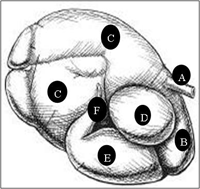
Diagram 1. Stomach of the Cow
A = Esophagus; B = Reticulum; C = Rumen;
D = Omasum; Due east = Abomasum; F = Small Intestine Begins
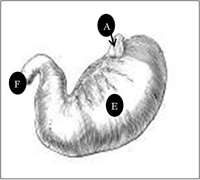
Diagram ii. Stomach of the Canis familiaris
A = Esophagus; E= Stomach Body; F = Small Intestine Begins
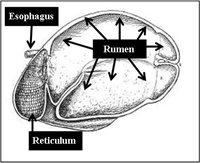
Diagram 3. The Reticulo-rumen.
All three diagrams courtesy of Sudz Publishing
On the right, a cow's stomach is shown in Diagrams 1 and 3, and a dog's stomach is shown in Diagram 2. Utilise the letters that characterization the stomach parts in Diagrams 1 and 2 to identify the similarities and differences between the two stomachs. Notice that the letters exercise more than place the structures; they also map the path food travels on its digestive journey. The canis familiaris'south stomach is a lot like our own. See how many more structures at that place are in the cow'south stomach? In the cow, rather than having a single pouch, in that location are four interconnected pouches, each with a unique part.
When a cow beginning takes a bite of grass, it is chewed very piffling before information technology is swallowed. This is a characteristic feature of the digestion in cows. Cows are known as "ruminants" because the largest pouch of the stomach is chosen the rumen. Imagine a large 55-gallon trashcan. In a mature cow, the rumen is well-nigh the aforementioned size! Its large size allows cows to consume large amounts of grass. After filling upwards on grass, cows observe a place to prevarication down to more thoroughly chew their food. "Just they have already eaten," you lot might be thinking. This is true, just cows are able to voluntarily "united nations-consume" their food. This process of swallowing, "un-swallowing", re-chewing, and re-swallowing is called "rumination," or more than normally, "chewing the cud." Rumination enables cows to chew grass more than completely, which improves digestion.
The reticulum is directly involved in rumination. The reticulum is made of muscle, and past contracting, it forces food into the cow's esophagus which carries the food dorsum to the oral cavity. The reticulum (alphabetic character B, Diagram 1) is sometimes called the "honeycomb" because of its distinct honeycomb-like appearance. Run into Figure ane for a shut-up look.
With a elementary stomach, the dog, and fifty-fifty man, cannot assimilate many plant materials. A cow'southward rumen is dissimilar because information technology functions like a large food processor. In fact, millions of tiny organisms (mainly bacteria) naturally live in the rumen and help the cow past breaking down plant parts that cannot be digested otherwise. These tiny organisms then release nutrients into the rumen. Some nutrients are captivated correct away; others have to travel to the small intestine before being captivated. To help the moo-cow's trunk capture and absorb all these nutrients, the inside of the rumen is covered by small finger-like structures (called papillae). In Figure ii, find that the rumen wall resembles a shag rug or the imitation wool on the inside of a winter coat. The papillae give the rumen wall this texture.
There is little separation between the first two sections of a moo-cow's stomach, the reticulum and the rumen (Diagram 3), so food and water pass dorsum and forth easily. The next pouch in the stomach is the omasum (letter D, Diagram 1). This pouch acts like a behemothic filter to proceed establish particles within the rumen while allowing water to laissez passer freely. By keeping grass pieces and other feed inside the rumen, bacteria have more fourth dimension to pause them down, providing even more nutrients for the cow. Figure 3 shows the multiple layers of the omasum.
Later on the grass pieces and other feed are broken down to a small-scale enough size, they eventually pass through the omasum and enter the abomasum (letter E, Diagram one). The prefix "Ab-," means from, off, or abroad from. The abomasum, then, is located just across the omasum. Refer dorsum to Diagrams i and 2 and notice that the eye of the domestic dog's tum and the abomasum of the cow'due south stomach are both labeled with the letter "Due east". This illustrates a similarity in function. You see, the abomasum has the same basic function as the stomach of the dog, human being, or other mammal, which is the production of acids, buffers, and enzymes to suspension down food. After passing through the abomasum, partially digested food enters the small intestine where digestion continues and nutrients are absorbed.
The Benefits
The rumen efficiently extracts nutrients from food other animals cannot digest. For this reason, cows tin can eat plant materials (such as seed coats, shells, and stems) that remain after grains are harvested for homo consumption. These remaining materials are sometimes called "by-products." Feeding by-products helps farmers and businesses salvage money past not having to pay to dispose of these extra materials and make money past selling the by-products equally animal feed.
When oil is extracted from grains (for example, soybean oil from soybean seed and Canola oil from rapeseed), or grains are used to mash alcohol or make fuel-ethanol, plant by-products are made. Although key nutrients (similar fatty, carbohydrate, and protein) are removed from the plant materials during processing, when used properly, these by-products tin be fed to cows. The complex nature of their four-compartment stomachs and their rumen bacteria permit cows to swallow and thrive on plant past-products that other animals cannot digest.
The better we understand the cow'due south digestive arrangement, the better nosotros are able to formulate diets and manage our herds for the optimal production of the nutritious meat and milk we routinely enjoy. So, the adjacent time you have a cool glass of milk, a loving cup of ice foam, or a juicy hamburger, you will know that these products came from cows fed grass, grain, or past-products, and yous volition know, How Cows Consume Grass.
Source: https://www.fda.gov/animal-veterinary/animal-health-literacy/how-cows-eat-grass
0 Response to "After the Feed Has Been Chewed and Swallowed Again"
Post a Comment