what does conjugation do to proton nmr peaks
| HIGH RESOLUTION NMR SPECTRA This folio describes how you lot interpret simple high resolution nuclear magnetic resonance (NMR) spectra. It assumes that y'all take already read the background folio on NMR then that you empathize what an NMR spectrum looks like and the use of the term "chemical shift". It also assumes that you know how to interpret simple low resolution spectra. | |||||||||||||||||||||||||
| Note:If yous haven't read the background page on NMR or the page on low resolution NMR, yous actually ought to read them before you go on. | |||||||||||||||||||||||||
| The difference between loftier and low resolution spectra What a low resolution NMR spectrum tells y'all Remember:
Loftier resolution NMR spectra In a high resolution spectrum, yous find that many of what looked like single peaks in the low resolution spectrum are split up into clusters of peaks. For A'level purposes, you volition simply demand to consider these possibilities:
You can become exactly the aforementioned information from a loftier resolution spectrum every bit from a low resolution one - you merely care for each cluster of peaks as if it were a single i in a low resolution spectrum. Only in addition, the amount of splitting of the peaks gives you important actress information. Interpreting a high resolution spectrum The due north+one rule The amount of splitting tells you virtually the number of hydrogens attached to the carbon atom or atoms next door to the one you are currently interested in. The number of sub-peaks in a cluster is ane more than than the number of hydrogens attached to the next door carbon(s). So - on the assumption that there is only 1 carbon atom with hydrogens on next door to the carbon we're interested in (normally truthful at A'level!):
| |||||||||||||||||||||||||
| Note:You probably won't demand to know the origin of the n+i rule, simply if you are interested at that place is a page on the reasons for splitting which you could expect at. | |||||||||||||||||||||||||
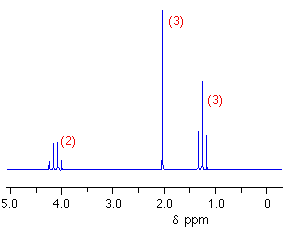
| Using the n+one rule What information tin can you lot go from this NMR spectrum? | |||||||||||||||||||||||||
| Note:The nmr spectra on this page have been produced from data taken from the Spectral Data Base of operations Arrangement for Organic Compounds (SDBS) at the National Institute of Materials and Chemical Inquiry in Nihon. Whatever pocket-sized errors that I've introduced during the process of converting them for employ on this site won't affect the argument in any way. | |||||||||||||||||||||||||
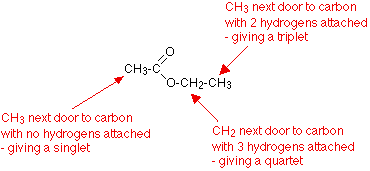
| Presume that you lot know that the compound above has the molecular formula C4H8O2. Treating this as a low resolution spectrum to start with, there are three clusters of peaks and so three different environments for the hydrogens. The hydrogens in those three environments are in the ratio two:3:three. Since there are 8 hydrogens altogether, this represents a CH2 group and two CH3 groups. What about the splitting? The CH2 group at about 4.1 ppm is a quartet. That tells you that it is side by side door to a carbon with three hydrogens attached - a CH3 group. The CH3 group at about 1.3 ppm is a triplet. That must be next door to a CH2 grouping. This combination of these two clusters of peaks - 1 a quartet and the other a triplet - is typical of an ethyl group, CHiiiCHtwo. It is very common. Get to recognise it! Finally, the CH3 grouping at about 2.0 ppm is a singlet. That means that the carbon next door doesn't have any hydrogens attached. So what is this compound? You lot would also utilize chemical shift information to help to identify the environs each grouping was in, and eventually y'all would come up with: | |||||||||||||||||||||||||
| Note:You now know how to get the information you lot need from NMR spectra, but it ofttimes isn't easy to fit all that information together into a final formula. Y'all simply need to practise! Get through all the examples in past papers from your Exam Board. How complicated they are volition vary markedly from Board to Lath. Some of the compounds you will come beyond may exist very unfamiliar. Don't forget to use the information in chemic shift tables - if your examiners include some obscure group, it's almost certain you lot will need to use it. Take all the hints that are going! | |||||||||||||||||||||||||
| Two special cases Alcohols Where is the -O-H tiptop? This is very confusing! Dissimilar sources quote totally different chemical shifts for the hydrogen atom in the -OH group in alcohols - oft inconsistently. For example:
The trouble seems to be that the position of the -OH pinnacle varies dramatically depending on the conditions - for example, what solvent is used, the concentration, and the purity of the alcohol - peculiarly on whether or not it is totally dry out. | |||||||||||||||||||||||||
| Help!Do you need to worry about this? Not really - you can assume that in an exam question, any NMR spectrum will exist consistent with the chemical shift information you lot are given. | |||||||||||||||||||||||||
| A clever style of picking out the -OH tiptop If yous measure an NMR spectrum for an alcohol similar ethanol, then add a few drops of deuterium oxide, DtwoO, to the solution, allow it to settle and and so re-measure the spectrum, the -OH peak disappears! By comparing the two spectra, you can tell immediately which peak was due to the -OH group. | |||||||||||||||||||||||||
| Notation:Deuterium oxide (sometimes chosen "heavy water") is simply h2o in which all the normal hydrogen-1 atoms are replaced by its isotope, hydrogen-2 (or deuterium). | |||||||||||||||||||||||||
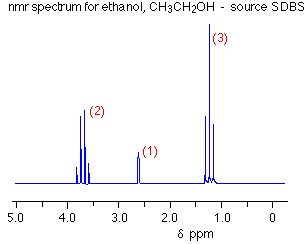
| The reason for the loss of the peak lies in the interaction between the deuterium oxide and the alcohol. All alcohols, such as ethanol, are very, very slightly acidic. The hydrogen on the -OH group transfers to i of the lone pairs on the oxygen of the water molecule. The fact that here nosotros've got "heavy water" makes no difference to that. The negative ion formed is nigh probable to bump into a elementary deuterium oxide molecule to regenerate the alcohol - except that at present the -OH group has turned into an -OD group. Deuterium atoms don't produce peaks in the same region of an NMR spectrum as ordinary hydrogen atoms, so the meridian disappears. You might wonder what happens to the positive ion in the first equation and the OD- in the 2d ane. These get lost into the normal equilibrium which exists wherever yous have water molecules - heavy or otherwise. The lack of splitting with -OH groups Unless the alcohol is absolutely costless of whatever h2o, the hydrogen on the -OH group and any hydrogens on the next door carbon don't interact to produce any splitting. The -OH peak is a singlet and you don't accept to worry well-nigh its consequence on the next door hydrogens. The left-paw cluster of peaks is due to the CH2 group. It is a quartet because of the 3 hydrogens on the next door CH3 group. You can ignore the effect of the -OH hydrogen. Similarly, the -OH peak in the eye of the spectrum is a singlet. It hasn't turned into a triplet because of the influence of the CH2 group. | |||||||||||||||||||||||||
| Notation:The reason for this is quite complex, and certainly goes beyond A'level. Information technology lies in the very rapid interchange that occurs between the hydrogen atoms on the -OH grouping and either water molecules or other alcohol molecules. To notice out virtually it you lot will have to read either a degree level organic chemistry book or one specifically almost NMR. For A'level purposes merely accept the fact that -OH produces a singlet and has no effect on neighbouring groups! If you are interested, you can read more about the OH grouping in NMR in two articles from Michigan State Academy: NMR1 Look nether "Hydroxyl Proton Substitution and the Influence of Hydrogen Bonding" NMR2 Wait under "Hydrogen Bonding Influences" Don't wait these to exist easy reading though - this is university level stuff. | |||||||||||||||||||||||||
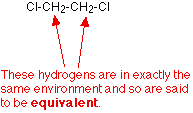
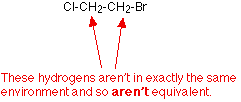
| Equivalent hydrogen atoms Hydrogen atoms fastened to the same carbon cantlet are said to be equivalent. Equivalent hydrogen atoms accept no consequence on each other - so that i hydrogen atom in a CH2 group doesn't cause any splitting in the spectrum of the other one. But hydrogen atoms on neighbouring carbon atoms can also be equivalent if they are in exactly the same surroundings. For example: These four hydrogens are all exactly equivalent. You would become a single elevation with no splitting at all. You merely take to change the molecule very slightly for this no longer to be truthful. Because the molecule at present contains dissimilar atoms at each end, the hydrogens are no longer all in the same environment. This compound would give two separate peaks on a low resolution NMR spectrum. The high resolution spectrum would show that both peaks subdivided into triplets - because each is side by side door to a differently placed CH2 group. A comment about NMR and benzene rings At this introductory level, all you can safely say nigh hydrogens attached to a benzene band is how many of them there are. If y'all accept a molecular formula which has 6 or more carbon atoms in it, then it could well contain a benzene ring. Await for NMR peaks in the 6.0 - 9.0 range. If you are given a number similar five or iv alongside that peak, this but tells you how many hydrogen atoms are attached to the band. If there are 5 hydrogens attached to the band, then there is merely one group substituted into the ring. If in that location are 4 hydrogens attached, and then in that location are ii split groups substituted in, so on. At that place should always be a total of half dozen things fastened to the ring. Every hydrogen atom that is missing has been replaced by something else. Splitting patterns involving benzene rings are far too complicated for this level, generally producing complicated patterns of splitting chosen multiplets. | |||||||||||||||||||||||||
| Note:If y'all are unfortunate enough to have examiners who ask about splitting in benzene rings at this level (for xvi - 18 yr old chemistry students), look carefully at the question and mark scheme so that you lot tin see exactly what they want, and merely larn that. But it may well be that all they want is for you to notice the number of hydrogen atoms involved in the band (meet in a higher place). | |||||||||||||||||||||||||
© Jim Clark 2000 (last modified March 2016) | |||||||||||||||||||||||||





Source: https://www.chemguide.co.uk/analysis/nmr/highres.html
0 Response to "what does conjugation do to proton nmr peaks"
Post a Comment